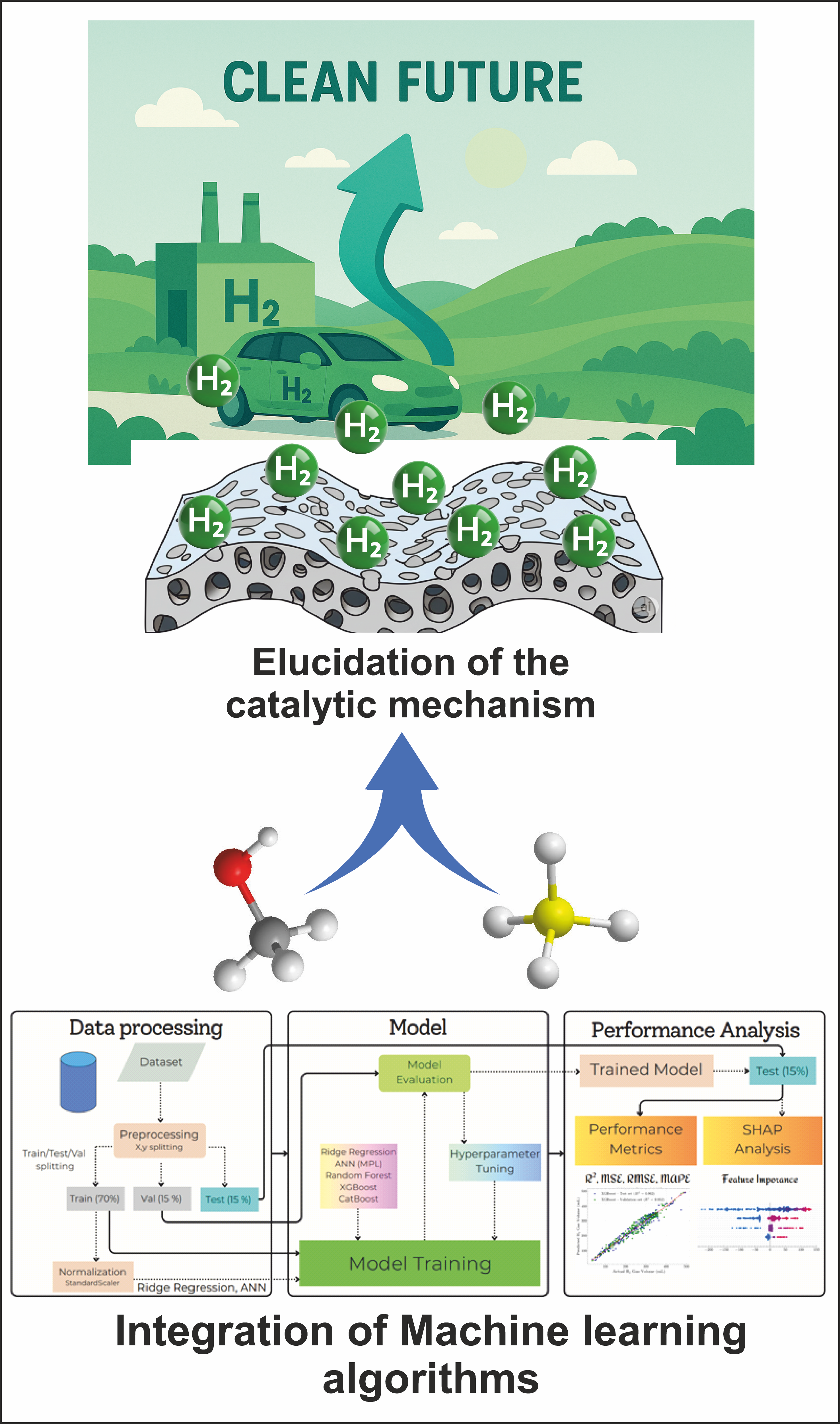
At Future Polymers and Materials Research Group, we believe that the development of advanced functional materials requires more than synthesis, characterization, and performance evaluation alone.
In our recent studies on hydrogen production and related material systems, we have increasingly adopted an integrated research framework that combines statistical analysis, machine learning methods, and density functional theory (DFT) calculations with experimental investigations.
This approach allows us to move beyond simple performance reporting. Statistical analysis helps identify significant variables and strengthens the reliability of experimental interpretations. Machine learning enables the modeling of complex relationships, reveals hidden patterns in experimental data, and supports the prediction of promising material designs. DFT calculations provide molecular-level insight into interactions, electronic structure, and possible mechanistic pathways.
By combining these methods, we aim not only to evaluate material performance, but also to understand why that performance emerges and how more effective systems can be rationally designed.
We believe that this integrated perspective is becoming increasingly important not only for hydrogen production studies, but also for catalysis, adsorption, and the broader design of next-generation functional materials.
As FPM, we will continue to expand our research activities through the combination of experimental rigor, data-driven modeling, and molecular-level understanding.